Quick Answer
One person with five AI agents replaces a 6-person content team at 5% of the cost. $200-$400/month vs $15,000-$25,000 in salaries. Build one agent per week — validate each before chaining.
Monday morning. She opens her laptop. No team standup. No Slack pings.
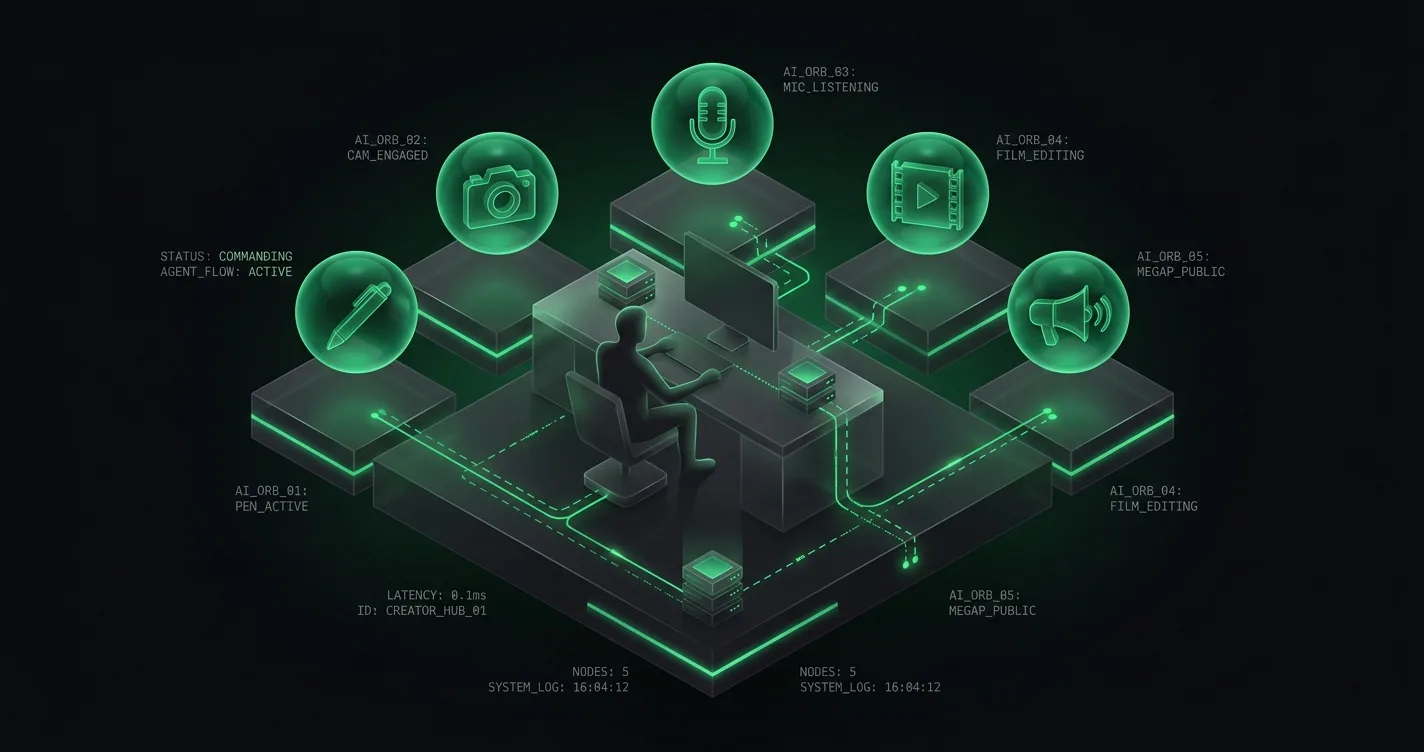
One person. Five AI agents. A content pipeline that produces scripts, storyboards, visuals, voiceovers, and finished posts on a weekly schedule that used to require six people.
By Friday evening, her content is scheduled across three platforms. Total human input: about two hours of review.
Here is how she built it. And why most people who try this approach fail on step one.
The 5-Agent Content Pipeline
Definition
A system of specialized AI agents — each handling one stage of content production (research, writing, visuals, voiceover, editing) — chained together with validation gates. One human oversees the sequence; the agents do the work.
The pipeline maps one agent to each weekday: Script, Storyboard, Visual Generation, Voiceover, Edit and Post.
One creator oversees each stage. She does not operate them. The result is a full content team output at roughly five percent of the cost.
A six-person content team costs fifteen to twenty-five thousand dollars per month in salaries. The AI stack runs two hundred to four hundred. That is not a typo.
But the gap between "four hundred dollars a month" and "actually working" is where most people crash.
How to Build the Pipeline
The most common mistake is obvious. People try to build all five agents at once.
Teams that deploy a full pipeline before validating individual agent quality create compounding problems. Each agent introduces its own failure modes. Chain five together and a single quality issue in the Script Agent cascades through Storyboard, Visual, Voiceover, and Edit. By the time you catch it, you have wasted four stages of work.
Here is the rollout that actually works.
Weeks one and two: Deploy the Script Agent first. Configure it with your keyword list, brand glossary, and competitor URLs. Run it parallel to your existing research process. Does it find topics you would have found? Does it miss anything critical? Only move to week three when the agent briefs match or exceed your own.
Weeks three and four: Add the Writing Agent. Train it on your ten best-performing pieces. Set explicit rules for vocabulary, heading structure, and linking. Start with high-volume, low-stakes formats. Newsletter drafts, social posts. Not your flagship blog content.
Week five: Establish the QA Checkpoint. Codify a manual quality checklist. Fact verification, non-negotiable voice markers, SEO rules. Run it manually first. Automate once your criteria are precise enough that a script can enforce them.
Week six and beyond: Integrate the Distribution Agent. Only after QA reliability is confirmed. Publishing flawed content at scale is worse than publishing nothing at all.
Monthly: Run the Performance Feedback Loop. Feed published content metrics back into agent configurations. This prevents the pipeline from plateauing after month two.
Each stage has a validation gate before the next one starts. If the Script Agent produces a brief with unsourced claims, it does not reach the Storyboard Agent. If the Visual Agent generates off-brand images, the Voiceover Agent never sees it.
The Tools
The orchestration layer matters more than the individual tools. You need something that chains agents together with conditional logic. "If agent A passes, trigger agent B. If agent A fails, flag for human review."
n8n handles this well. It is open-source, has over four hundred integrations, and lets you build conditional workflows without writing code. Each agent becomes a node in an n8n workflow, with validation gates between them.
Claude Code works for agent development and content generation. It understands context across long documents, which makes it reliable for maintaining brand voice across multiple outputs.
For visual generation, the options depend on your content type. Canva AI or Midjourney for static assets. Runway or Pika for short video clips. Pick one tool, train it on your brand guidelines, and do not switch mid-pipeline. Consistency matters more than quality.
ElevenLabs produces the most natural-sounding AI voices right now. Google text-to-speech is free but sounds robotic. Piper is open-source and decent for budget setups.
For video assembly, CapCut API handles basic editing automation. Buffer or Later manage cross-platform publishing. The Edit Agent job is assembly and quality check, not creative direction.
| Tool | Cost | What It Replaces | Setup Difficulty |
|---|---|---|---|
| n8n | Free (self-hosted) | Project management, coordination | Medium |
| Claude Code | $20/month | Writer, researcher | Low |
| ElevenLabs | $5–22/month | Voice actor | Low |
| Runway/Pika | $12–35/month | Videographer | Medium |
| CapCut API | Free | Video editor | Medium |
| Buffer/Later | $5–15/month | Social media manager | Low |
| Total | $42–94/month | 5–6 people |
What Breaks First
Every pipeline fails. The question is whether it fails quietly or loudly.
AI hallucinations are the most common failure. The Script Agent invents a statistic. The Voiceover Agent reads it with confidence. By Friday, you have published something false. Fix it with Retrieval-Augmented Generation and citation scanners. The Script Agent must attach a source URL to every claim. No source means the QA gate blocks it.
Off-brand voice happens when agents are not trained on enough examples. Fix it with style linters. Before any output leaves a stage, run it through a brand voice checker that flags deviations from your approved vocabulary, sentence length limits, and tone markers.
Silent pipeline failures are the most dangerous. An API key expires. The Visual Agent produces blank images. The Edit Agent assembles them anyway because nobody told it to check. Fix it with validation gates between every stage. If an agent produces zero output or output below a quality threshold, the pipeline halts and sends a Telegram alert instead of publishing garbage.
Data quality problems cause 85 percent of failed AI projects. Not the AI itself. If the Script Agent feeds the pipeline weak topics, every downstream agent produces weak content. Garbage in, garbage out, multiplied by five. Invest more time in the first agent than all the others combined. A strong Script Agent makes every other agent better.
Treat your content pipeline like a software build pipeline. Versioned artifacts. Explicit acceptance tests between stages. Automated linters for heading structure, keyword density, and banned terms before any human review. Audit logs of prompts, model versions, and outputs. Monthly schema and prompt updates based on postmortems.
The Real Numbers
The economics are straightforward:
- AI stack cost: $200–$400 per month
- Six-person team equivalent: $15,000–$25,000 per month in salaries
- ROI timeline: 60–90 days
- Time freed: 15–25 hours per week from repetitive content tasks
Solo founders are running zero-employee companies at $1M–$5M per year. The model works when the system is designed right.
But "designed right" is the hard part.
The people who succeed with AI content pipelines start with one agent. They validate it. They add the second. They validate it. They build a system where each agent output is checked before it reaches the next one.
It is not glamorous. But it is the difference between a pipeline that runs for months and one that crashes on day three because the Script Agent hallucinated a statistic that made it through all five stages unchallenged.
Start with one agent. Chain the rest slowly. Gate everything.
Key Takeaways
- Five AI agents replace a 6-person content team at 5% of the cost
- Build one agent at a time — validate before chaining to the next
- [n8n](https://n8n.io) orchestrates the pipeline; Claude Code generates the content
- Validation gates between every stage prevent cascading failures
- Start with the Script Agent — it determines the quality of everything downstream
Read Next
Frequently Asked Questions
For volume and consistency, yes. A single creator with 5 AI agents can produce 10-15 pieces of content per week — output that previously required 4-6 people. However, AI agents don't replace creative direction, brand voice development, or audience relationship building. Think of them as a production team that executes your vision at 10x speed. The creator sets strategy and reviews output; the agents handle the labor-intensive middle steps.